Wednesday, June 2, 2010

Casa Batlló- Barcelona

Casa Batlló (Catalan pronunciation: [ˈkazə bəʎˈʎo, bədˈʎo]), is a building restored by Antoni Gaudí and Josep Maria Jujol, built in the year 1877 and remodelled in the years 1904–1906; located at 43, Passeig de Gràcia (passeig is Catalan for promenade or avenue), part of the Illa de la Discòrdia in the Eixample district of Barcelona, Spain.
The local name for the building is Casa dels ossos (House of Bones), and indeed it does have a visceral, skeletal organic quality. It was originally designed for a middle-class family and situated in a prosperous district of Barcelona.
The building looks very remarkable — like everything Gaudí designed, only identifiable as Modernisme or Art Nouveau in the broadest sense. The ground floor, in particular, is rather astonishing with tracery, irregular oval windows and flowing sculpted stone work.
It seems that the goal of the designer was to avoid straight lines completely. Much of the façade is decorated with a mosaic made of broken ceramic tiles (trencadís) that starts in shades of golden orange moving into greenish blues. The roof is arched and was likened to the back of a dragon or dinosaur. A common theory about the building is that the rounded feature to the left of centre, terminating at the top in a turret and cross, represents the sword of Saint George (patron saint of Catalonia), which has been plunged into the back of the dragon.


information: wikipedia

Tuesday, June 1, 2010

What children learn when they grow up

Things I learned when from a child I turned into an adult:

- I know there is no a prince riding white horse who is looking for me, most likely just the horse will find me.

- I don’t believe Snow White exists, just her step mother

- Not a kiss turns a frog into a prince, a bottle of whiskey does.

- Good things may happen to good girls, but bad girls get much more.

- Adults’ mischief is more dangerous.

- I know that if I eat much, I’ll grow up. But now that growth affects my width instead of height.

- When mommy gives me money it’s not a reward, now it means I’m a looser.

- Seek and hide games are still popular, but when u get caught it gets ugly.

- I’m not that happy for having birthdays.

- I don’t hide my friends’ secrets from their mothers but from their boyfriends.

Sunday, May 30, 2010

Young more lonely than the old


Loneliness is more prevalent among the young than those past retirement age, a survey suggests, amid profound changes in the way we live and interact.Across all ages one in 10 people in the UK often feel lonely, the Mental Health Foundation has found, a state which can impact upon one's physical health. The charity highlights the decline of community and a growing focus on work. Technology can isolate but is also an unrivalled means of connecting people, the poll of 2,256 people concludes. The Lonely Society report described the generational differences uncovered in its survey as "striking". Nearly 60% of those aged between 18 to 34 questioned spoke of feeling lonely often or sometimes, compared to 35% of those aged over 55.
But it is possible there are generational differences in the subjective interpretation of what it is to be lonely. In addition, the survey did not break down the differences between the active 55-year-old enjoying retirement and the frail, isolated 80-year-old. Chronic elderly isolation was brought to the fore earlier this year with the deaths of a Northamptonshire husband and wife, whose bodies were found in their frozen home in the middle of Britain's coldest winter. The changing nature of the family, with fewer children who themselves often move away, has increased the prospect of elderly isolation. This has also become more likely as a result of longer life expectancies, the report noted. But neighbourhoods have also changed, with the local services such as post offices that tended to form the heart of old communities on the decline. The report also found gender differences, with more women than men reporting loneliness, and more likely to feel depressed as a result. It highlighted the fact that the proportion of people living alone, both male and female, had doubled between 1972 and 2008.

Facebook era

New technology meanwhile may be both a boon and a burden, the report suggested. At one level, it has enabled people to make connections they might not otherwise have made, and virtual friendships can evolve into real-life relationships. The report cites the example of the parenting website Netmums, which says that because of contacts made online 10,000 women meet face-to-face every month, reducing the sometimes intense sense of isolation new mothers can experience. But there are also concerns that technology is being used as a replacement for genuine human interaction. Nearly a third of young people questioned for the report said they spent too much time communicating with friends and families online when they should see them in person. Whether this has any genuine biological impact is unclear, but it has been suggested that physical presence is needed for the hormone oxytocin to be released - believed to be the chemical process underpinning the relationship between social contact and healthy hearts.
Manhattan meetingsSarah Brennan, head of the charity YoungMinds, said: "The young people we work with tell us that talking to hundreds of people on social networks is not like having a real relationship and when they are using these sites they are often alone in their bedrooms. "Loneliness is a big problem which we need to start to tackle. In the last few years our communities have broken down and become atomised. We need to foster these relationships again and invest in our young people's wellbeing so that they have somewhere to go or to turn to when they are feeling lonely."
Dr Peter Byrne of The Royal College of Psychiatrists said the report challenged the perception that loneliness was restricted to isolated, elderly "Eleanor Rigbys", with its findings on the young. He added: "Economic changes that disrupt people's work-life balance and family life, and send people hundreds of miles for work, are likely get worse during this recession. Openness about being lonely, and vulnerable friends and neighbours, is an important first step." But while many more of us may be living alone in cities, with some thought loneliness can be averted, the report suggested. "For example, Manhattan in New York has 50% lone households, more than anywhere else in the United States, yet its 'urban village' model sustains social networks because people habitually use alternative meeting places, including cafes and public spaces," the authors wrote. "According to evolutionary psychology, cities could in fact be our perfect environment because of the demands they make on our complex social brains, but only if they are well designed."


Original link to the article:
http://news.bbc.co.uk/2/hi/health/8701763.stm


Casa Milà- Barcelona

Casa Milà, commonly known as La Pedrera is the largest civil building designed by Antoni Gaudi. The apartment block was constructed between 1906 and 1910. It was Gaudi's last work before devoting himself to the construction of the Sagrada Familia.
Rich businessman was impressed by the Casa Battló, an expressionist building designed by Gaudi. He commissioned Gaudi to construct an apartment building on a corner site at the Passeig de Gracia, in the Eixample district.
On the outside, the undulating balconies look like a series of waves. The top floor, attic and the extraordinary roof are open to visitors. The apartment on the top floor gives an idea of how the interior must have looked at the beginning of the 20th century. The roof is probably the most extraordinary of the building. It features a number of surrealistic colorful chimneys. Many of them look like warriors in a science fiction movie, others look more frivolous. The roof also features a bench similar to the one in Park Guell.


Saturday, May 29, 2010

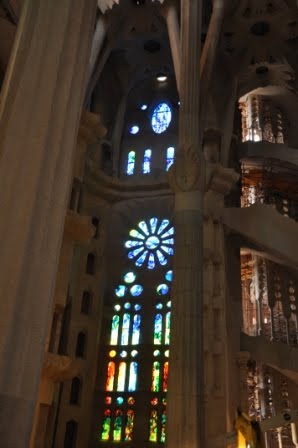
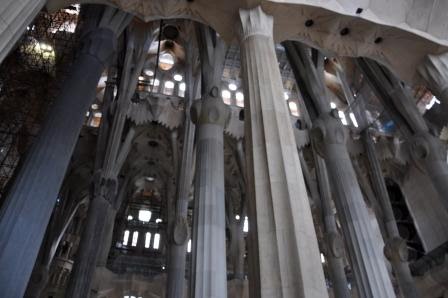
La Sagrada Familia - Church of the Holy Family

The Sagrada Famlia is the most famous work of Gaudi to which he dedicated all his life to the extreme that he lived inside the precinct to closely follow the works. To point out, that is the unique great temple at present in construction everywhere in the world.
La Sagrada Familia is one of Gaudi's most famous works in Barcelona. It's a giant temple that has been under construction since 1882 (that's not a typing error!) and it's not expected to be completed for between 30 to 80 years ( time for completion varies depending on different sources of information)